Ahead of the MODS-OECD-ADB Global Workshop 2026, the second SDMx+AI primer webinar introduced participants to essential skills for publishing, disseminating and accessing statistical data using the .Stat Suite and SDMx APIs.
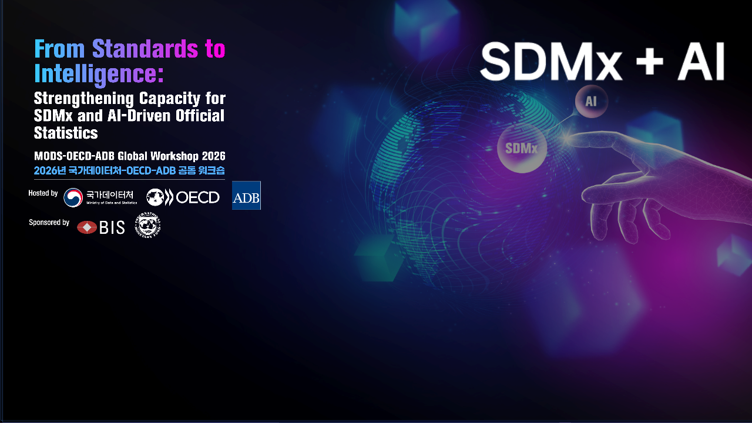
Held on 27 August 2026, the 90-minute session, Essential skills: .Stat Suite and SDMx APIs, was moderated by Brian Buffett and delivered by the OECD’s David Barraclough. It formed part of the preparations for the September workshop, From Standards to Intelligence: Strengthening Capacity for SDMx and AI-Driven Official Statistics, jointly organised by MODS, the OECD and the Asian Development Bank.
Building on the first primer webinar, the session continued the practical workflow developed around an exchange-rate dataset. Participants moved from improving the data and its SDMx structures to loading, checking and publishing it through .Stat, before exploring how the resulting data could be queried through an SDMx REST API and used by AI-enabled tools.
Making statistical data more interoperable and AI-ready
The first part of the webinar focused on how SDMx modelling choices affect both interoperability and AI readiness.
For statistical data to be understood reliably by large language models and other AI tools, data series need to be self-describing rather than relying on a dataset name or file structure to provide essential context. The item being measured and its unit of measure should be represented clearly and separately, while standard structural metadata should be used wherever possible.
Why metadata matters for AI
A central message from the session was that high-quality metadata does more than facilitate conventional data exchange. It also gives AI-basedsystems the context they need to discover, compare and interpret statistical information correctly.
Self-describing data series can be compared more easily across datasets. Structures based on standard metadata support interoperability, while clearly defined measures and units reduce the risk of AI systems, and human users, making false assumptions about what a statistical value represents.
By making meaning explicit within the data structure, statistical organisations can create datasets that are more reliable for both traditional applications and emerging AI-driven services.
Understanding the .Stat Suite
The webinar also introduced the role of the Statistical Information System Collaboration Community (SIS-CC) and the main capabilities of the .Stat Suite.
Participants were introduced to three of the Suite’s main components:
- .Stat Data Lifecycle Manager, which allows statistical producers to manage data and metadata and monitor data operations;
- .Stat Core, the data warehouse where statistical structures and data are securely stored and made accessible through SDMx APIs; and
- .Stat Data Explorer, which enables users to discover, search, visualise and use data while also exposing it through SDMx APIs.
Together, these components provide an SDMx-native environment for managing and disseminating official statistics.
From the design space to publication
The next stage of the practical workflow focused on publishing. Using .Stat Data Lifecycle Manager, participants saw how structures and data can first be loaded into a design workspace, where they can be checked before publication. Once the data and metadata are ready, they can be transferred to a release workspace and made available to users.
This separation between design and release provides an opportunity to review and validate statistical content before it enters the public dissemination environment. It also helps organisations maintain a more controlled and traceable publication process.
Accessing data through the SDMx REST API
Once published, the data can be accessed programmatically through the SDMx REST API. The webinar explained the main elements of an API query and demonstrated how a query can be adapted to retrieve different statistical series.
SDMx APIs allow data aggregators, applications and analytical tools to access standardised statistical data directly. They also provide connectors to commonly used environments such as Python, R, Excel and Power BI, supporting greater integration between official statistics and external tools.
These capabilities will be used during the training sessions and hackathon at the Seoul workshop, where participants will work directly with SDMx APIs and explore their application in AI-driven workflows.
Connecting SDMx data with natural-language tools
The final demonstration introduced StatGPT, an initiative of the IMF Statistics Department. The SDMx-driven platform allows users to query, transform, analyse, visualise and interpret statistical data through a natural-language interface.
The demonstration illustrated how well-structured data and high-quality metadata can enable AI tools to identify relevant statistical information and interpret it more reliably. Rather than replacing statistical standards, AI applications depend on those standards to understand what data mean and how different observations relate to one another.
This connection between standards, APIs and natural-language interfaces is central to the SDMx+AI approach: combining interoperable statistical infrastructure with new ways for users and machines to discover and work with official statistics.
Preparing participants for the Seoul workshop
By the end of the second primer webinar, participants had explored SDMx modelling practices that improve interoperability and AI readiness, the role and main components of the .Stat Suite, the process for publishing SDMx-compliant data and the use of SDMx REST APIs.
Together, the two primer webinars established a common technical baseline ahead of the MODS-OECD-ADB Global Workshop 2026, taking participants through the workflow from preparing and validating data and structures to publication, API access and AI-enabled discovery.
The workshop, taking place in Seoul from 15 to 17 September 2026, will build on these foundations through two days of training and a final innovation day and hackathon focused on practical SDMx+AI applications.
Missed the second primer webinar?
Watch the recording or download the presentation materials to catch up on the session and prepare for the next stage of SDMx+AI 2026.
As a reminder this is an intermediate to advanced technical event, therefore participants are expected to have completed prior SDMx training before attending with familiarity of the SDMx Information Model essential. We strongly recommend completing relevant courses available through the SDMx Learning Resources (e.g. .Stat Academy), including introductory SDMx modules where appropriate. This preparation is vital to ensure you can fully engage with and benefit from the capacity-building sessions and hackathon activities.