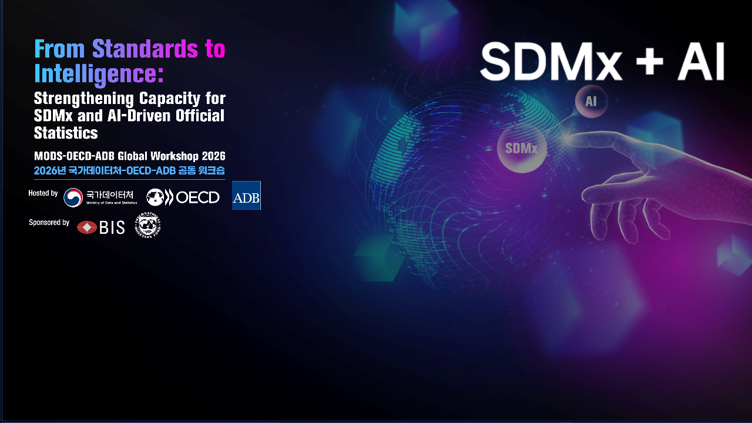
Ahead of the MODS-OECD-ADB Global Workshop 2026, the first SDMx+AI primer webinar brought participants together for a practical introduction to FMR and SDMx Lab — two key tools supporting SDMx adoption, capacity building and data dissemination workflows.
Held on 30 July 2026, the 90-minute session, Essential skills: FMR and SDMx Lab, was delivered by Benjamin Keller and Dr Jonas Rieger from the Bank for International Settlements (BIS). It formed part of the preparatory activities for the September workshop, From Standards to Intelligence: Strengthening Capacity for SDMx and AI-Driven Official Statistics, jointly organised by MODS, the OECD and the Asian Development Bank.
The webinar focused on a concrete mission: how to prepare spreadsheet-based statistical data for dissemination. Using an exchange-rate dataset as a practical example, participants followed the process from one input file to two essential outputs: validated data in SDMx-ML 2.1 and the matching SDMx structures needed to make that data meaningful and ready for dissemination through the .Stat Suite.
A hands-on environment for learning and prototyping
A central part of the session was the introduction of SDMx Lab, a personal sandbox environment designed to make SDMx learning and prototyping easier. The presentation highlighted a common challenge for many organisations: setting up environments for training, proof-of-concepts or experimentation can be time-consuming, while testing directly on production systems is often not possible or appropriate.
SDMx Lab responds to this by giving users access to a modular, cloud-based SDMx testbed where they can explore, test and learn without complex setup. The environment brings together several components, including FMR, the .Stat Suite, Excel-based tools, notebook access, FMR Workbench and AI services, each supporting a different part of the SDMx workflow.
Participants were guided through which tool to use for which task: FMR for validating or converting SDMx submissions, FusionXL for working with metadata through a spreadsheet interface, .Stat Suite Data Explorer for viewing data in interactive graphics, and notebook access for computing aggregates from data in the lab.
Understanding the SDMX information model
The webinar also helped participants strengthen their understanding of the SDMx information model. The session walked through how dataflows, data structure definitions, dimensions, measures, attributes, concepts and codelists connect to one another — and why these relationships matter when preparing data for exchange and dissemination.
A key message from the training was that statistical values cannot stand alone: the receiver also needs the structures that give those values meaning. In practical terms, this means that preparing data for dissemination is not only about converting a file into the right format. It is also about ensuring that the underlying metadata, structure definitions and code lists are complete, aligned and ready for use by downstream systems.
From validation to handover
The practical workflow followed in the webinar was structured around four main steps: validate, convert, enrich and hand over. Participants saw how FMR can be used to validate a submission against target structures, convert data into the required SDMx format, add the structures and dependencies required by the target environment, and prepare the final handover to .Stat.
The session also covered how to diagnose issues, decide whether corrections are needed in the data or the metadata, and revalidate submissions before release. For material changes to SDMx artefacts, the presenters emphasised the importance of assessing the impact before editing, creating a traceable working version, reviewing the change and only then publishing the agreed version.
Preparing participants for the Seoul workshop
By the end of the primer, participants had been introduced to the main SDMx Lab components, the role and basic interface of FMR, methods for tracing SDMx artefact dependencies, and the use of FMR API calls to request structures in the required format. These outcomes are directly aligned with the preparatory objectives set out for the primer webinar series.
The session helped establish a common technical baseline ahead of the September workshop in Seoul, where participants will explore how standards, metadata and emerging AI tools can support more reliable, interoperable and AI-ready statistical systems.
A second primer webinar, focused on .Stat Suite and SDMx APIs, will take place on 27 August 2026. It will build on the first session by continuing the workflow from the handover stage into the .Stat environment.
Missed the first primer webinar?
Watch the recording to catch up on the session and prepare for the next stage of SDMx+AI 2026.